Why Aeration Matters More in Kansas City Than Most Places
Kansas City sits on clay soil — the kind that compacts under foot traffic, mowing equipment, and rain over the course of a season. That compaction is the root cause of most lawn problems homeowners call us about: thin patches, drainage pooling in the yard, slow fertilizer uptake, struggling grass in high-traffic areas.
The fix isn't more fertilizer. It's aeration — pulling plugs from the soil to break up the compaction layer, improve drainage, and let air, water, and nutrients actually reach the root zone.
We do this every year on most KC metro properties. It's the single highest-ROI service we offer.
The Right Window: Late August Through October
Cool-season grasses dominate Kansas City lawns — tall fescue primarily, with some Kentucky bluegrass in older neighborhoods. Cool-season grass has two active growth periods: spring (March–May) and fall (August–October). Fall is the better window for aeration by a significant margin.
Here's why fall wins:
Soil temperature: Aeration is most effective when the grass is actively growing and can recover quickly. Soil temperatures in Kansas City stay above 50°F through mid-October most years — the threshold for cool-season root activity.
Post-summer stress: Your lawn takes a beating from Kansas City's July and August heat. Aeration immediately after the summer stress period, combined with overseeding, is the fastest path to a denser lawn by spring.
Overseeding timing: Fall aeration creates the ideal seedbed for overseeding. The plugs break apart after a few days, creating loose soil contact for new seed — and the cooling fall temperatures are optimal germination conditions for fescue.
No competition from weeds: Spring aeration disrupts pre-emergent weed barriers. Fall doesn't have that problem. Your crabgrass barrier stays intact.
How Aeration Works
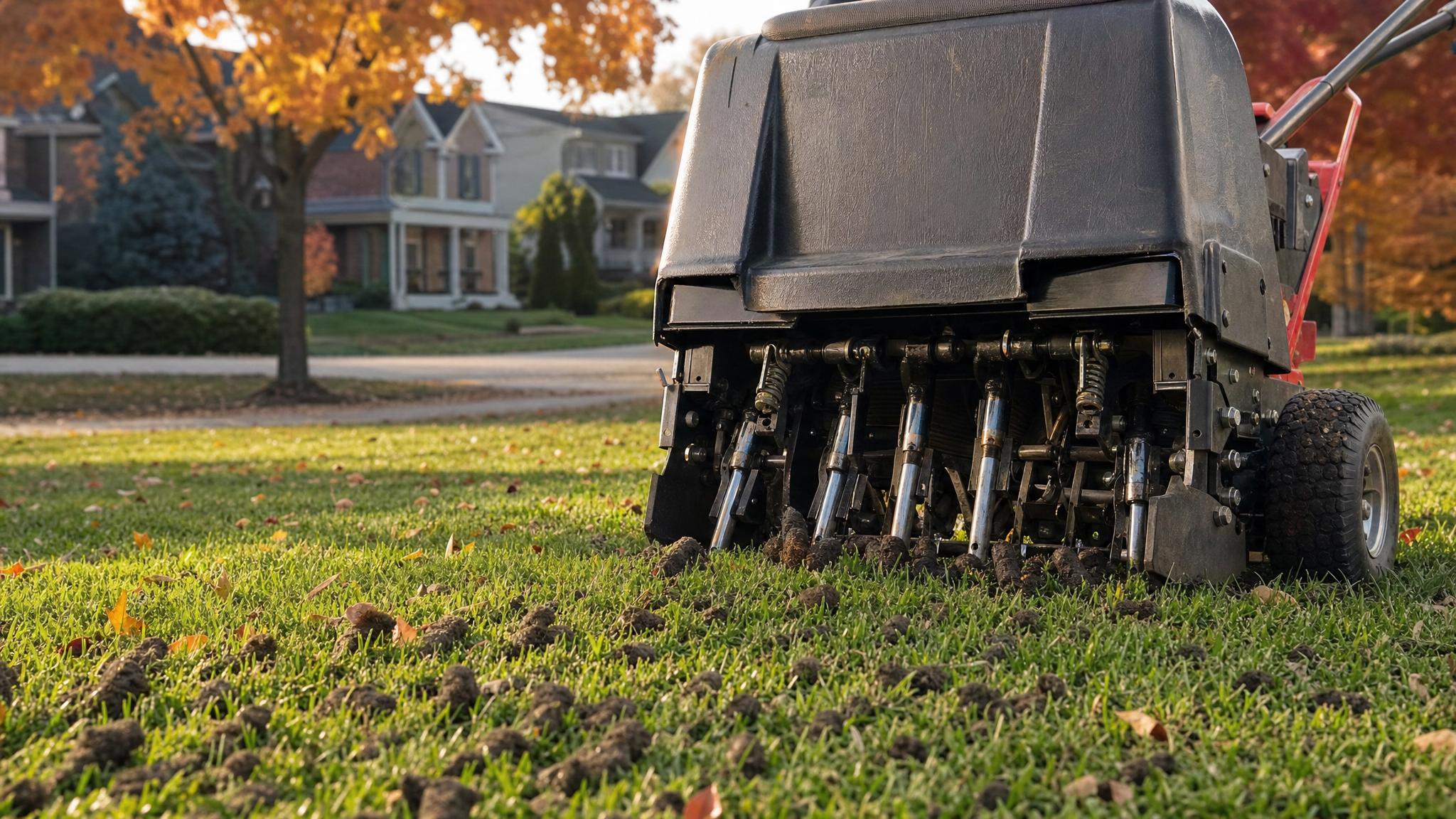
A core aerator pulls cylindrical plugs of soil — typically 2–3 inches deep and about 3/4 inch in diameter — across the entire lawn in a grid pattern. Those plugs break down on the surface over 1–2 weeks, acting as a light top-dressing as they decompose.
What you want to see after aeration:
- Plugs left on the surface (they're supposed to be there — don't rake them up)
- Holes spaced every 3–4 inches in a grid
- Coverage of the entire lawn including edges
What doesn't work:
- Spike aeration (spike shoes or spike-drum rollers) — these compact soil laterally rather than removing it
- Single-pass aeration on heavily compacted clay — we always do at least two passes on KC clay
The Clay Problem in Kansas City
Jackson County and Johnson County soil is heavy clay. Clay soil has excellent nutrient-holding capacity, but it compacts significantly more than sandy or loam soils under normal use. A 1,000-square-foot lawn that gets walked on regularly will need aeration every year to keep compaction from building up.
We see lawns in Overland Park, Blue Springs, and Lee's Summit that haven't been aerated in 5+ years. The thatch layer has built up to 1.5–2 inches, and the root zone can't breathe. Fertilizer sits on top of the thatch instead of reaching the soil. One aeration visit doesn't fix years of compaction — it takes 2–3 consecutive annual aeration cycles to genuinely restore a heavily compacted KC lawn.
Should You Overseed at the Same Time?
In most cases, yes. Overseeding immediately after aeration is the most efficient use of the soil prep work the aerator just did.
Here's the timing that works in Kansas City:
- Aerate: Late August through September 30 (ideal window)
- Overseed: Immediately after aeration on the same visit
- Keep moist: The top inch of soil needs to stay consistently moist for 14–21 days post-seeding
- First mow: Wait until new grass reaches 3.5–4 inches before mowing
The variety of seed matters for Kansas City specifically. We use endophyte-enhanced tall fescue blends that have been tested for heat tolerance — KC summers are hard on fescue, and variety selection makes a real difference in long-term density.
What Aeration Costs in the Kansas City Metro
Aeration on an average Kansas City residential lot (typically 6,000–9,000 square feet of turf area) runs $75–$150. A combined aeration and overseeding service runs $200–$400 depending on turf area and seed rate.
We quote flat, all-in prices — no per-square-foot math for you to do. Call us or submit an online estimate request and we'll give you a specific number for your property.
Signs Your Lawn Is Telling You It Needs Aeration
You don't always need to look at a calendar. These are the signs we see on lawns that are ready:
- Water puddles in low areas after moderate rain rather than soaking in
- Thatch layer over 1/2 inch (peel back a section of turf and measure — healthy thatch is 1/4 inch max)
- Footprints that stay compressed rather than bouncing back in minutes
- Grass that looks stressed in mid-summer heat despite adequate watering
- Thin or bare patches in high-traffic areas (front walkway, between the fence gates, etc.)
Any one of these is a signal. Multiple of them together and aeration should happen this fall.
Book Fall Aeration Before September
Fall aeration in the Kansas City metro books out fast. We typically start taking requests in August and schedule through mid-October. If you wait until October to call, you may be looking at a 3–4 week wait.
For the best results — especially if you're combining aeration with overseeding — book in late August or early September. That gives us time to get on your lawn while the soil temperature is still ideal and before the late-September schedule fills up.
Call or text us at (816) 555-0147 or request an estimate online. We'll give you a flat all-in quote the same day.